

Preventing Creep on Submersible Pumps Bearings
Submersible pumps are widely used in a variety of applications such as Construction, Waste water, Mining, Agriculture and General industry. Most Submersible pumps comprise of a vertical electric drive motor coupled directly to the impeller. They are required to operate for long periods with the minimum amount of maintenance.
Bearing Arrangement
The bottom, locating bearing, is generally a Double-Row Angular Contact Ball Bearings or a pair of Angular Contact Bearings. This reacts the axial load and radial load generated by the pumped fluid. The bearing is heavily loaded and needs to be correctly selected to reach target life. The top free bearing, is generally a Deep Groove Ball Bearings. This takes a light radial load. C3 clearance is generally used to compensate for clearance reduction due to heat generation from the electric motor.
Creep Phenomenon on Top Bearings
The lightly loaded top bearing should, theoretically, have a very long life. However, its life is sometimes drastically reduced by creep. The combined effect of light radial load and loose fit in the Housing can result in creep between Outer ring and Housing. Creep is a phenomenon where relative slippage occurs between fitted surfaces. Creep produces a polish on the Bearing ring surface, occasionally accompanied by scoring or wear.
Countermeasure
One popular countermeasure used by Pump manufacturers is to machine an annular groove in the Housing bore and to insert an O-ring. The O-ring prevents creep between Bearing outside diameter and Housing.
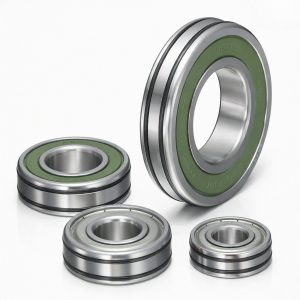
Features of Creep-Free Bearings
NSK Creep-Free Bearings offer more, with their integrated double O-rings, they provide better creep prevention. They provide Submersible pump manufacturers with the following advantages:
› Improved creep prevention
› Easy assembly. The Creep-Free bearings can be fitted with a loose Housing bore tolerance
› Housing is re-usable as very little abrasion occurs on the Housing bore
› Cost reduction. Pump manufacturers do not need to machine a groove in the Housing bore and insert their own O-ring.
Source: NSK Ltd – nsk.com